SentrySafe SFW123GDC vs SFW123DSB: Digital or Dial? (October 2026)
In the SentrySafe SFW123GDC vs SFW123DSB comparison, choose the GDC for frequent keypad access or the DSB for occasional dial access. Their fire and water protection certifications match, so choose around your opening routine and storage needs.
On this page (9 sections)
- SentrySafe SFW123GDC vs SFW123DSB: what changes?
- Do both safes have the same fire and water protection?
- Will your documents and valuables fit?
- Which safe is easier to place at home?
- How should you set up either safe?
- How do you care for the safe and its contents?
- Who should buy each model, and who should skip both?
- Common mistakes that make either safe harder to use
- SentrySafe SFW123GDC vs SFW123DSB: your final decision
Choose the SentrySafe SFW123GDC for frequent keypad access or the SFW123DSB for occasional access with a dial. In the SentrySafe SFW123GDC vs SFW123DSB comparison, the main buying decision is your daily routine, since their fire and water protection certifications match.
The GDC suits a household that regularly puts away small valuables and wants help seeing them in a dim spot. The DSB suits someone who mainly stores papers and prefers a dial without keypad battery upkeep.
Neither model saves floor space over the other. Before choosing, check your contents, the door clearance and how you'll move the safe into place.
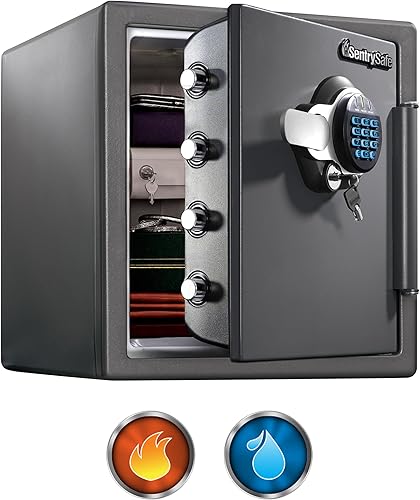

SentrySafe SFW123GDC vs SFW123DSB: what changes?
The lock and interior organization are the meaningful differences. Choose the GDC for its access and storage conveniences, or the DSB if a dial and shelf better match your habits.
Both have steel construction, 4 live-locking bolts, a pry-resistant hinge bar and bolt-down hardware. Those shared features don't establish a burglary resistance grade or prove that either lock style is more secure.
Don't choose from the small score gap alone. A safe you can operate comfortably and organize well is a better fit than one whose extra features you'll rarely use.
Does the SentrySafe SFW123GDC keypad or SFW123DSB dial fit your routine?
The GDC lets you set your own digital combination and has a backlit keypad. That makes it the stronger choice if you expect to open the safe often or place it where room lighting is limited.
Its secondary locking key adds an access detail you need to understand before use. Don't assume that key is an emergency override for the electronic lock; read how the two locks work together.
The DSB uses a dial combination, which suits someone comfortable following a turning sequence. It removes keypad battery upkeep, but you still need to learn the sequence and align the dial carefully.
For shared household access, consider every authorized user's comfort with the chosen lock. Someone who struggles to see dial marks or follow repeated turns may prefer a keypad, while someone who dislikes battery maintenance may prefer the dial.
Our guide to digital keypad vs dial combination safes explains the broader trade-offs. Neither access style removes the need to protect the combination.
Which interior fits your belongings?
The GDC favors small-item organization, while the DSB favors separating contents into levels. The GDC has an interior light, locking drawer, key rack, door tray and door pocket; the DSB includes a shelf.
A drawer can give jewelry or other small valuables a defined place. That helps keep them apart from document envelopes, although it doesn't establish separate fire protection inside the safe.
The shelf makes sense if you want papers in one area and smaller containers in another. Don't assume either model's fittings can be swapped, removed or repositioned unless the instructions confirm it.
Choose from a contents list rather than the number of compartments. Extra fittings help only when they suit the shape of what you need to store.
Do both safes have the same fire and water protection?
Yes, their protection certifications match. SentrySafe provides UL Classified fire protection for 1 hour at 1700°F and ETL Verified water protection for 24 hours in water up to 8 inches deep on both models.
Both are also ETL Verified to withstand a 15-foot fall during a fire and remain closed. That concerns remaining closed under defined conditions, not permission to drop or roughly handle the safe.
The fire protection covers documents, valuables, DVDs and USB drives under the classified conditions. Don't extend that claim to every type of electronic device, storage medium or heat-sensitive object.
A time limit isn't a countdown you can rely on during a real fire. Conditions vary, and neither model promises that every item will remain undamaged after every event.
Water depth matters just as much as duration. A location where floodwater could rise above the stated depth calls for a different storage plan, even if water would recede quickly.
Read whether SentrySafe safes are fireproof and waterproof for help interpreting those limits. Our explanation of fireproof vs fire resistant also clarifies why the word “fireproof” shouldn't replace reading the protection details.
Will your documents and valuables fit?
Both safes offer 1.23 cubic feet of storage, with interior dimensions of 12.6 in wide, 11.9 in deep and 13.8 in high. Those measurements are a starting point, not a promise that every folder will fit around the interior fittings.
Measure your actual document envelopes, folders and containers. Include tabs, clasps and thick edges, since those can turn a close fit into an awkward one.
A sheet of paper fitting inside doesn't mean a large binder or document wallet will fit comfortably. You should be able to remove an envelope without bending it or pulling out most of the safe's contents.
Group your planned contents by use: papers you rarely need, items you retrieve regularly and small valuables that need separate containers. This shows whether drawer storage or shelf space will be more useful.
Leave room for future papers and for your hand to reach the back. Filling every gap on the first day makes the safe harder to use and increases the chance that contents interfere with closing.
If your stack is already large, read what size safe you need for home documents before choosing either model. A different interior size may help more than switching between these two layouts.
Which safe is easier to place at home?
Neither has a smaller exterior footprint. Both measure 16.3 in wide, 19.3 in deep and 17.8 in high, so measure the same basic space for either choice.
The GDC requires 14.75 in of clearance for its door to open fully. Check the DSB's instructions for its exact door clearance rather than applying that number to both models.
Mark the safe's footprint on the floor and consider the space beyond it. Nearby walls, cabinet doors and furniture can leave room for the closed box while blocking the opening or your reach inside.
Check that you can see the lock and stand or sit comfortably enough to operate it. A location that forces you to crouch awkwardly can make careful dial use or keypad entry needlessly difficult.
These are heavy safes, around 86 to 90 lb, so plan the delivery route before moving day. Door thresholds, tight turns and stairs may require suitable equipment and help.
Choose a stable location that allows the installation method SentrySafe specifies. Don't put either safe on a shelf or cabinet simply because its exterior dimensions fit.
Both include bolt-down hardware, but the floor and surroundings still need checking before drilling. Follow the exact model's instructions, and check for concealed utilities and any restrictions on altering the property.
Our guide to choosing a fireproof home safe covers the broader placement decision. Installation should follow the manual rather than a generic anchoring method.
How should you set up either safe?
Learn the lock with the door open before storing anything important. Keep the instructions nearby, follow the opening and closing steps, and practice until you can repeat them without guessing.
For the GDC, install the recommended batteries and set the combination as directed. SentrySafe recommends 4 high-quality, name-brand alkaline AAA batteries with an expiration date 8 to 10 years ahead.
Choose a code that isn't an obvious birthday, address or repeated digit pattern. Keep a secure recovery record outside the safe, separate from anything an intruder could easily connect to its location.
For the DSB, learn the exact turn directions and stopping points from the manual. Don't rely on a remembered sequence from another combination lock, since the required steps can differ.
If more than one person needs access, have each person practice before you add valuables. Plan how a trusted person could find the necessary instructions or access information if you're unavailable.
Check the secondary key procedure on the GDC and store the key securely outside it. A key inside the locked safe can't help you manage access from outside.
Complete the placement and anchoring steps before loading the safe. Once installed, confirm that the door closes freely and the lock operates normally without contents pressing against it.
How do you care for the safe and its contents?
Keep the door area clear and inspect stored papers regularly. Neither lock style removes the need to check that contents remain dry, organized and easy to retrieve.
Avoid putting damp papers, wet envelopes or recently cleaned containers inside. Let items dry fully before storage, and follow SentrySafe's moisture-control guidance for the exact model.
Don't pack papers tightly against the door or locking parts. If closing takes unusual force, open the door and rearrange the contents rather than pushing harder.
Keep the door edge and contact surfaces free of loose paper and debris. Use the cleaning method in the manual, and don't add oil, adhesive seals or other treatments without manufacturer guidance.
For the GDC, include battery inspection and replacement in your routine. Keep a suitable spare set outside the safe, and address changes in keypad behavior according to the instructions.
For the DSB, keep the dial readable and operate it without force. If access becomes difficult, use SentrySafe's support process rather than trying to alter the lock yourself.
Store a simple inventory elsewhere so you know what the safe contains. Our guide to storing important documents at home can help you arrange originals, copies and access records.
Who should buy each model, and who should skip both?
Buy the GDC for regular access; buy the DSB for a deliberate, occasional-access routine. Skip both if your contents, placement or protection needs fall outside what these models provide.
Buy the GDC if small valuables come in and out often
The GDC makes sense for someone who regularly stores jewelry, keys or document envelopes and values visibility. Its lighting and divided storage support finding smaller items without searching through a single stack.
Skip it if battery upkeep is a task you're unlikely to follow. Also reconsider it if you don't want to manage a secondary key alongside the combination.
Buy the DSB if papers stay stored for longer periods
The DSB suits someone who wants shelf organization and is comfortable taking time with a dial. It fits an occasional-access routine where removing keypad battery upkeep matters more than illuminated controls.
Skip it if you find dial marks difficult to read or turning sequences hard to repeat. For a shared safe, one person's preference shouldn't leave another authorized user unable to open it reliably.
Choose another safe if the fit or protection is wrong
Neither model is a portable document box or a good choice for a location you must change often. Their weight and installation needs favor a planned, lasting spot.
Choose a different size if folders only fit when bent or your contents already fill the available space. Don't solve a capacity problem by leaving items loose around the door.
For unusually valuable belongings, check the burglary protection and insurance requirements you need. Fire and water certifications don't answer that question, and a dial alone doesn't establish stronger theft protection.
Common mistakes that make either safe harder to use
Avoid buying by capacity alone or treating the protection labels as unlimited coverage. The most costly mismatch is a safe that doesn't fit its contents or the risks at its chosen location.
Another mistake is planning only for the closed safe. You need room for the door, access to the lock and enough space to remove a folder without twisting it.
Don't keep every copy of critical information in one place. A separate secure record or suitable backup can help if the safe is inaccessible after an emergency.
Also avoid assuming the GDC's extra fittings increase its disaster protection. Choose those features for access and organization, since both models carry the same certifications here.
For a closer look at either configuration, use our SFW123GDC review or SFW123DSB review. Focus on the model that fits your routine after completing the size and placement checks.
SentrySafe SFW123GDC vs SFW123DSB: your final decision
For the SentrySafe SFW123GDC vs SFW123DSB decision, choose the GDC if regular access, visibility and small-item storage are your priorities. Choose the DSB if you prefer a dial, want shelf organization and expect to retrieve contents less often.
Before ordering, write down 3 things: your largest stored item's measurements, the available door clearance and who needs access. Those checks will settle more than another comparison of shared features.
If either model fails those checks, use our home safe guide to compare other sizes and layouts. Buy the safe that fits your storage plan, then follow its instructions for installation and ongoing care.
Frequently asked questions
What is the difference between the SFW123GDC and SFW123DSB?
The main differences are access and organization. The SFW123GDC has a digital keypad, secondary locking key, interior light and locking drawer, while the SFW123DSB has a dial combination and shelf.
Choose around how often you open the safe and how you want to arrange its contents.
Do both SentrySafe models have the same fire protection?
Yes. SentrySafe provides the same UL Classified protection for 1 hour at 1700°F on both models, plus ETL verification that they remain closed after a 15-foot fall during a fire.
These defined conditions don't promise that every stored item will survive every fire without damage.
Are the SFW123GDC and SFW123DSB waterproof?
Both have ETL Verified water protection for 24 hours in water up to 8 inches deep. That is a defined depth and duration, not unlimited flood protection.
Consider the likely water level at your chosen location, and follow SentrySafe's installation instructions rather than assuming any placement provides equal protection.
Do the SentrySafe safes need batteries?
The GDC's keypad requires 4 AAA batteries, while the DSB's dial doesn't require keypad batteries. SentrySafe recommends high-quality, name-brand alkaline batteries for the GDC, with an expiration date 8 to 10 years ahead.
Follow the manual for replacement and keep a suitable spare set outside the locked safe.
Does the SFW123GDC's secondary key replace the digital combination?
Don't assume the secondary locking key replaces the digital combination. SentrySafe describes the GDC as having both an electronic lock and a secondary key lock.
Read its instructions to understand how they work together before closing the door, and keep the key somewhere secure outside the safe.


