Digital Keypad vs Dial Combination Safe: Which Is Better? (October 2026)
In a digital vs combination safe comparison, choose a keypad for frequent access or a dial for a battery-free opening routine. Match fire protection, storage size and recovery options to your needs before choosing the lock.
On this page (10 sections)
- Digital vs combination safe: what is the main difference?
- Which lock is easier for your household to use?
- Which of these safes fits your situation?
- What happens if the batteries die or you forget the code?
- Which safe has enough usable storage space?
- Do digital and dial locks change fire or water protection?
- Where should you put and secure the safe?
- How should you set up and care for either lock?
- What mistakes should you avoid before buying?
- Digital vs combination safe: which should you choose?
Choose a digital safe for frequent code entry and a dial combination safe for a battery-free opening routine. The digital vs combination safe decision starts with how you'll use the lock, but fire protection, storage space and secure installation matter just as much.
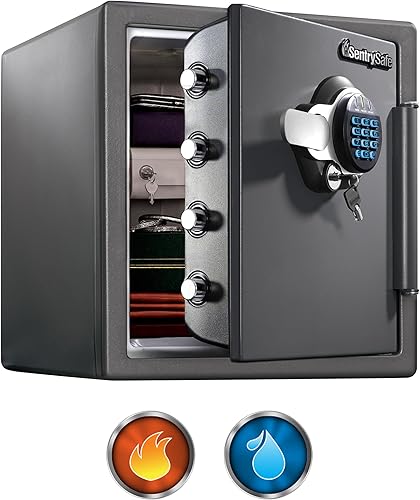
The SentrySafe SFW123GDC suits households that open their safe regularly. The SentrySafe SFW123DSB suits occasional document access, while the smaller Bonsaii Electronic Keypad Safe fits limited cabinet space.
Start with the items you need to protect, then choose an opening method you can use comfortably. A convenient lock on the wrong kind of safe won't meet your storage needs.

Digital vs combination safe: what is the main difference?
A digital safe accepts a code through buttons, while a mechanical combination safe uses a rotating dial. Both use a combination, so “digital versus dial” is the clearer way to describe the choice.
Keypads remove the need to count dial turns and stop at exact marks. They also bring battery care into your routine, along with any model-specific recovery steps.
A mechanical dial doesn't depend on keypad power. It does require you to remember the numbers, turning directions and sequence, even if months pass between openings.
Neither approach makes a safe automatically better against theft. The safe's construction, anchoring and any independent security classification need separate attention.
Which lock is easier for your household to use?
A keypad usually suits frequent access, while a dial suits unhurried access without battery changes. Choose around the people who will open it, including anyone who may need access in your absence.
For regular use, pressing a code is a simpler routine than completing several dial turns. That makes keypad entry a sensible choice for documents or valuables you take out and return often.
Consider eyesight and hand movement too. Small dial marks and precise stopping points can be difficult for some people, while small keypad buttons may also be awkward.
The SFW123GDC's backlit keypad helps you see the controls in a dim location. A backlight still doesn't replace placing the safe where you can reach its handle and read instructions comfortably.
Digital vs dial combination safes for shared access
Choose a routine every authorized user can complete alone. Don't assume a family member knows how to open a dial safe just because they know the numbers.
Have each person practice the full process with the door open. Include closing and securing it, since shutting a door and engaging its lock are separate steps on many safes.
A shared code also needs a plan for when access should change. Confirm the model's code-change procedure rather than assuming every safe lets you change its combination in the same way.
Which of these safes fits your situation?
Choose the SFW123GDC for regular access, the SFW123DSB for occasional access, or the Bonsaii for a smaller storage space. The 2 SentrySafe models suit buyers who also need the fire and water protection described below.
SentrySafe SFW123GDC: for regular document access
The SFW123GDC fits households that want code entry and help seeing small belongings. Its interior light, locking drawer, key rack, door tray and door pocket offer places to separate papers from smaller items.
Use that organization to keep frequently needed items easy to reach. Packing every gap can make a larger safe frustrating to use and can leave belongings in the door's path.
Skip this model if you want to avoid battery maintenance or only have a small cabinet available. Also make sure you understand the secondary locking key before choosing it for shared household access.
SentrySafe SFW123DSB: for papers you rarely retrieve
The SFW123DSB fits buyers who prefer a mechanical dial and can take their time opening it. Its shelf helps divide the interior so smaller belongings don't have to sit beneath a stack of folders.
It makes sense for a household archive that stays closed most of the time. Keep the opening instructions accessible to authorized users, especially when the safe goes unused for long stretches.
Skip it if precise dial turns are uncomfortable or if several users are unlikely to learn the sequence. A dial removes battery chores, but it doesn't remove the need for practice and a secure combination record.
Bonsaii Electronic Keypad Safe: for limited cabinet space
The Bonsaii fits a small collection of belongings where a larger safe won't fit. Its removable shelf lets you choose between separate storage levels and more vertical room, while the felt-lined bottom helps avoid scratches.
Skip it if your main goal is protecting original documents from fire or flood. Steel construction and a keypad don't establish either type of protection.
Its lighter body also makes secure attachment a key part of planning. Don't choose it simply because it's easy to carry into place and then leave it loose.
For more detail on the larger pair, see our SFW123GDC vs SFW123DSB comparison. Our digital keypad safes for home guide covers more keypad choices.
What happens if the batteries die or you forget the code?
Loss of power and a forgotten combination need different solutions. External power can run an electronic lock, but it doesn't supply the missing code.
The Bonsaii includes 2 emergency override keys and a USB-C backup power option. A power bank and cable aren't included, so prepare compatible equipment before you need it.
The SFW123GDC has a secondary locking key. Treat it as part of the locking system, not as a confirmed emergency bypass for dead batteries.
For any model, read the recovery instructions before putting important items inside. Keep the manual, model details and any ownership records somewhere secure that you can reach without opening the safe.
Store emergency keys outside the safe and away from an obvious nearby drawer. Keep the combination record separate from the safe so finding one doesn't immediately reveal the other.
A dial avoids a dead-keypad problem, but a forgotten dial combination still creates an access problem. Plan secure recordkeeping for either lock type.
Which safe has enough usable storage space?
Choose by interior dimensions and your largest item, then check capacity. Cubic feet alone won't tell you whether a folder fits flat or a case clears the door opening.
Both SentrySafe models have a 1.23 cu ft interior measuring 12.6 in wide, 11.9 in deep and 13.8 in high. The Bonsaii holds 0.6 cu ft, so it suits a smaller collection.
Measure folders with their tabs, jewelry boxes with their lids closed and any protective sleeves you plan to use. Don't assume a paper document fits just because the bare sheet fits.
Leave space to remove one item without emptying the safe. A little unused room is useful when your document stack grows or you add another small case.
Make a storage list with our guide to what to keep in a home safe. Then use our home safe size guide to turn that list into practical measurements.
Do digital and dial locks change fire or water protection?
Lock type doesn't determine fire or water protection. Both SentrySafe models here share the same classifications, so choosing their keypad or dial doesn't change those stated protections.
Both are UL Classified for 1 hour at 1700°F and ETL Verified for 24 hours in water up to 8 in deep. Both are also ETL Verified to remain closed after a 15 ft fall during a fire.
Those are specific conditions, not unlimited protection against every fire or flood. Read our explanation of what a 1-hour fireproof safe rating means before deciding what to store.
The Bonsaii doesn't have a confirmed comparable fire or water classification in the supplied specifications. Choose it for lockable storage, rather than treating it as a substitute for either SentrySafe's protection.
Fire protection and theft resistance are separate needs too. The SentrySafe models have steel construction, 4 live-locking bolts and a pry-resistant hinge bar, but those features alone don't establish a burglary classification.
Where should you put and secure the safe?
Choose a location with enough support, door clearance and room to operate the lock. A safe that fits a recess but can't open fully is poorly placed.
Both SentrySafe models measure 16.3 in wide, 19.3 in deep and 17.8 in high outside, and both weigh more than 85 lb. Plan the delivery route and final placement before moving either one.
The SFW123GDC needs 14.75 in of clearance for its door to open fully. Check the dial model's installation instructions for its clearance needs rather than assuming every detail matches.
The Bonsaii measures 13.78 in wide, 9.84 in deep and 9.84 in high and weighs 13.9 lb. Check cabinet support and access to the controls before choosing a shelf or compartment.
Both SentrySafe models include bolt-down hardware. The Bonsaii has pre-drilled installation holes and 2 expansion screws for cabinet installation.
Use the mounting method approved for the model and the surface beneath it. Follow the manual for any steps that affect water protection, and don't drill extra holes through the body.
Our home safe selection guide covers placement alongside other buying decisions. You can also browse the home safe category for alternatives.
How should you set up and care for either lock?
Complete the opening and closing routine with the door open before storing valuables. Check code entry, handle movement and any secondary lock exactly as the manual directs.
For a keypad, set your personal code using the supplied instructions. Avoid an obvious birthday, address or simple repeated number, and keep other people from watching as you enter it.
For a dial, practice the directions and stopping points until the sequence feels familiar. If you miss a number, restart according to the manual rather than guessing which turn will correct it.
SentrySafe recommends 4 high-quality, name-brand alkaline AAA batteries for the SFW123GDC, with expiration dates 8–10 years ahead. The Bonsaii uses 4 AA batteries.
Keep suitable replacement batteries outside the safe. Follow the manual's battery guidance, respond to low-battery warnings and confirm operation after a battery change before closing the door.
Keep the controls clean and dry using the maker's care instructions. Don't add oil or cleaning spray to a keypad, dial or keyhole unless the manual specifically calls for it.
Arrange contents clear of the bolts and door edge. Check stored papers periodically for dampness, and follow any moisture-control advice in the safe's manual.
What mistakes should you avoid before buying?
Don't choose by lock style before deciding what the safe must protect. Use this short checklist to catch problems that a keypad-versus-dial comparison can miss.
- Buying for capacity alone: A large volume doesn't guarantee your widest folder will fit.
- Confusing a secondary key with an override: Confirm what each key does and when it is required.
- Relying on USB-C to recover a code: Backup power addresses power loss, not forgotten credentials.
- Assuming heavy means secured: Plan suitable anchoring instead of relying only on weight.
- Expecting emergency-speed access: Neither a familiar keypad nor a practiced dial guarantees immediate access under stress.
- Ignoring future users: Someone else may need to retrieve documents when you're unavailable.
If high-value belongings are involved, check any insurer's safe requirements before ordering. Fire classification, lock convenience and an insurer's security requirements answer different questions.
Digital vs combination safe: which should you choose?
Choose the SFW123GDC if you'll open the safe regularly, want illuminated controls and can maintain batteries. Choose the SFW123DSB if access is occasional and everyone who needs it can follow a dial sequence.
Choose the Bonsaii for compact lockable storage when its smaller size and recovery options fit your needs. Skip it when confirmed fire or water protection is central to the job.
Before settling the digital vs combination safe choice, write down 3 things: your largest stored item, your required protection and who needs access. Eliminate safes that fail those needs, then choose the lock routine you prefer.
For alternatives built around different storage needs, compare our best home safes for documents and valuables.
Frequently asked questions
Is a digital keypad or dial combination safe better?
A digital keypad suits frequent access, while a mechanical dial suits people who want a battery-free lock routine. Neither lock type establishes fire protection or burglary resistance.
Choose the required protection and storage size first, then decide which opening method everyone who needs access can use reliably.
Does a digital safe need batteries?
Both keypad safes here use batteries. SentrySafe recommends 4 high-quality alkaline AAA batteries for the SFW123GDC, while the Bonsaii uses 4 AA batteries.
Keep replacements outside the safe, follow the manual for battery changes and confirm normal operation with the door open before securing your belongings.
Can you open a digital safe if its batteries die?
That depends on the safe's recovery system. The Bonsaii includes emergency override keys and USB-C backup power, but external power does not replace a forgotten code.
The SentrySafe SFW123GDC has a secondary locking key; don't assume it bypasses the keypad.
Follow the exact model's instructions before relying on a recovery method.
Is a dial safe harder to open?
A dial safe requires more steps than direct keypad entry because direction, turns and stopping points matter. Practice with the door open until you can complete the sequence without guessing.
If small dial marks or precise turns are difficult for you, choose a lock with controls you can use comfortably.
Are digital and dial safes equally fire resistant?
Fire protection depends on the safe's classification, not its lock style. Both SentrySafe models here are UL Classified for 1 hour at 1700°F.
The Bonsaii has no confirmed equivalent classification in the supplied specifications.
Choose protection for the contents you need to store rather than judging by the keypad or dial.