Fireproof Safe or Lockbox for Important Papers
Choose a fireproof safe or lockbox with documented fire endurance for papers kept at home, or a document bag when lightweight carrying comes first. Compare water protection separately, and measure your folders before choosing.
On this page (10 sections)
- Is a fireproof safe or lockbox better for important papers?
- When should you choose a document bag?
- When does a hard fire-resistant box make more sense?
- Is an organized document box worth choosing?
- How should you compare fire and water protection?
- How do you know whether your papers will fit?
- How should you set up and care for document storage?
- What mistakes should you avoid with a fireproof safe or lockbox?
- Frequently asked questions
- Which fireproof safe or lockbox should you choose?
Choose a fireproof safe or lockbox with documented fire endurance for important papers that stay at home, and a document bag when light carrying matters most. Water protection, theft resistance and document fit are separate decisions.
Among these options, the SentrySafe Charcoal Fireproof Chest suits home records when both fire exposure and water submersion matter. The smaller SentrySafe box suits a shallow stack of papers, while the Andyer and BALEINE bags serve different carrying and organizing needs.
Start with the records you need to protect, then choose the enclosure. A container that cannot close around your folders, or is too heavy for you to move, is the wrong fit even if its other features appeal.
Is a fireproof safe or lockbox better for important papers?
Choose by document protection and intended use, rather than the words “safe,” “lockbox” or “chest.” Those names alone do not establish fire endurance, water resistance or burglary protection.
A rigid chest helps keep papers from bending during storage, while a flexible bag is easier to carry and tuck away. Neither shape proves that the contents will survive a particular fire.
“Fireproof” is common product language, but every protection claim has limits. Read what fire-resistant and fireproof labels mean before treating the word as a promise of survival.
| Container | Choose it for | Main limit to consider |
|---|---|---|
| Flat document bag | A small packet you carry between locations | Limited structure and no automatic equivalence to a fire-rated chest |
| Compact rigid lockbox | A shallow stack kept at home | Interior depth and folder clearance |
| Fire and water chest | Home records needing both forms of protection | Weight and storage footprint |
| Compartment organizer | Separating papers, cards and small items | Pockets reduce the space available for bulky records |
A lock provides another kind of protection: access control. It can keep sensitive papers away from casual viewers, but a portable locked container can still be carried away.
If theft drives your decision, assess a safe's burglary resistance and approved installation method. Our complete guide to a fireproof safe for home explains the broader choices beyond document chests and bags.
When should you choose a document bag?
Choose a document bag for light carrying and a small, ready-to-move packet. It makes sense for records you take between home and another location, provided its protection matches your expectations.
The Andyer Fireproof Document Bag has 2 zippered pockets, a reflective strip and a hanging strap. Its simple layout suits someone who wants separate spaces for essential originals and reference copies without sorting through many small pockets.
Use it for a limited set of papers rather than an entire household archive. Put frequently needed items in one pocket and less-used records in the other so you can find them without emptying the bag.
Andyer describes the silicone-coated fiberglass bag as fireproof and water resistant, with waterproof sealed zippers. Those claims do not provide a timed, whole-container document-protection result comparable to the SentrySafe chests discussed below.
Skip this bag as your only fire barrier if your buying requirement is a stated duration of protection for papers. Also skip a soft bag if rigid support matters because your storage spot places pressure on the contents.
A reflective strip may help you locate the bag in low light, but emergency plans should not depend on finding belongings. Keep any evacuation packet accessible along your normal exit route, and leave without it if retrieving it would slow you down.
When does a hard fire-resistant box make more sense?
Choose a hard box when papers will stay at home and you want a rigid enclosure with basic privacy. The 2 SentrySafe options here share a stated fire duration, but their water protection and interior shapes differ.
SentrySafe Small Fire Box: for a shallow home archive
The SentrySafe Small Fire Box suits a modest stack of certificates, identity papers and small valuables. Its key lock comes with 2 keys, and carrying grips help when you need to relocate it.
SentrySafe states that it is UL classified for 30 minutes at 1550°F for documents and valuables. It also has ETL verification at that duration and temperature for CDs, DVDs, memory sticks and USB drives.
Its interior measures 13 in W x 8.75 in D x 3 in H, and it weighs about 17 lb. That shallow space favors a compact paper stack over thick folders or a growing collection of envelopes.
Choose it for fire-focused document storage when you have confirmed that your packet fits. Do not select it on the assumption that fire protection also establishes water-submersion protection.
Skip it for full-size legal sheets stored flat or for records you need to carry often. A box that is manageable across a room may still be awkward on stairs or during regular travel.
SentrySafe Charcoal Fireproof Chest: for fire and water concerns
The SentrySafe Charcoal Fireproof Chest suits home records when you want a specific water-submersion duration as well as fire protection. It has a tubular key lock, 2 keys and a carrying handle.
SentrySafe states that the chest is UL classified for 30 minutes at 1550°F to protect documents, small valuables, DVDs and USBs. It is separately ETL verified for 72 hours of water submersion.
The interior measures 12.8 in W x 8.5 in D x 4.4 in H, and the chest weighs 20 lb. Its extra height helps with stacked contents, but its depth leaves little clearance around the short edge of letter paper.
Measure envelopes and folders carefully because their edges can extend beyond the pages inside. Do not assume that a letter-size folder fits simply because a bare sheet does.
Choose this chest when water protection matters enough to justify the weight. Skip it for daily carrying or flat legal-size storage, and choose a different type of safe if resisting theft is your main goal.
Is an organized document box worth choosing?
Choose an organizer when finding the right item quickly matters as much as keeping records together. Separate pockets help households that manage several people's IDs, certificates and small media.
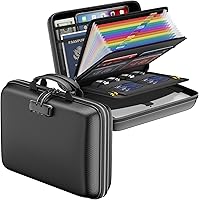
The BALEINE Fireproof Document Box has 12 mesh compartments, 16 card slots and 4 USB-drive pockets. Elastic straps help hold contents in place, while a luggage strap gives you another way to carry it during travel.
Its built-in combination lock suits someone who prefers remembering a code to managing keys. Treat that lock as basic access control rather than evidence of burglary resistance.
BALEINE claims its silicone fiberglass material resists flames up to 2200°F and is SGS certified to UL94 VTM-0. That material classification is not a timed document-protection classification for the complete organizer.
The brand also describes its dual zippers as waterproof against rain and spills. This does not establish protection during prolonged submersion.
Choose it for sorting a portable household packet, especially if loose cards and small items tend to get buried among papers. Skip it if your main requirement is a documented fire-endurance duration for the contents.
Assign each section a purpose before loading it, such as identity, property and insurance. No folders are included, so allow for the space any added sleeves or dividers will take.
For more container options, see our best fireproof document boxes guide. If larger sheets are your priority, compare our fireproof safe guide for legal-size documents.
How should you compare fire and water protection?
Compare the complete container's protection for its contents, then assess water protection separately. A high flame-temperature claim for fabric does not establish how long paper inside a closed bag remains protected.
Look for these distinctions before choosing:
- Protected contents: Paper protection does not automatically cover every kind of media.
- Exposure duration: A stated number of minutes gives you a basis for comparison that a temperature claim alone cannot.
- Scope: A material classification concerns the material, while a container classification addresses a different question.
- Water conditions: Rain, spills and prolonged submersion are different exposures.
A 30-minute classification describes performance under defined conditions. It does not predict the length or severity of a fire in your home, so do not treat it as a countdown during an emergency.
Fire response can also expose belongings to water. Read whether fireproof safes are waterproof before assuming that protection against heat covers that risk.
Check digital storage needs separately, too. Our guide to protecting hard drives and photos in a fireproof safe explains why a place suitable for paper may not suit every backup device or photograph.
How do you know whether your papers will fit?
Measure the largest item you will actually store, including its folder or envelope. Exterior dimensions and total capacity cannot tell you whether a document will lie flat.
Letter paper measures 8.5 x 11 in, while legal paper measures 8.5 x 14 in. Protective sleeves, folder tabs, sealed envelopes and bound records can all require more space.
Gather the intended contents into one stack and measure its width, depth and height. Add the records you expect to accumulate rather than buying around today's smallest possible packet.
For a rigid chest, account for rounded corners and any lid shape that reduces clearance. For a bag, remember that seams, zipper openings and filled pockets can limit usable space.
A useful fit check is to cut cardboard to the stated interior footprint and place your closed folders on it. This shows edge clearance, though it cannot reproduce the lid, corners or opening.
Do not fold an original simply to make a chosen box work if keeping it flat matters to you. Use our guide to fireproof storage for legal-size documents to narrow the search instead.
How should you set up and care for document storage?
Set up the container so it closes correctly, stays dry inside and remains easy to use. Follow the model's instructions for placement, moisture control, cleaning and any installation.
Choose a practical location
Choose a dry location where the container has stable support and enough room to open fully. Avoid a spot that requires moving several heavy objects every time you need a certificate.
A high shelf may be inconvenient for a heavy chest, while a damp floor creates avoidable storage problems. Consider who will lift the loaded container and whether they can do so safely.
Do not drill holes or add mounting hardware unless the instructions permit it. An improvised attachment can damage the enclosure or interfere with its intended protection.
Make access reliable
Practice opening and closing the container before adding important originals. Check that papers, straps and pocket contents stay clear of the lid, zipper or lock.
Keep spare keys somewhere secure and separate from the locked box. For a combination lock, follow the code-setting steps carefully and keep recovery information in a secure place outside the organizer.
Tell a trusted household member where essential records are and how authorized access works. A private box is less useful if nobody who needs the papers can reach them.
Keep moisture and clutter under control
Load only dry documents and inspect stored papers periodically for dampness, odor or discoloration. Follow the container's moisture-control directions, including any guidance on airing or suitable desiccants.
Wipe dirt away using the recommended cleaning method, and inspect closures for trapped debris or damage. Do not paint, coat or modify fire-resistant surfaces or seals.
Review contents when insurance, identity or property records change. Remove expired reference copies so the container remains focused on records worth protecting.
What mistakes should you avoid with a fireproof safe or lockbox?
Avoid buying one feature as a substitute for another. A lock, a flame-resistant fabric and a waterproof zipper each address different needs.
The most common buying and use mistakes are:
- Choosing by exterior size: Insulation and wall thickness can leave much less room inside.
- Overfilling: A bulging bag or crowded chest may not close as intended.
- Assuming a handle means easy carrying: Add the contents to the empty container's weight.
- Relying on portability for theft protection: A small locked container can leave with its contents.
- Keeping every copy together: One damaged or inaccessible container can take out the entire record set.
- Packing an emergency bag too heavily: Carrying comfort matters more than filling every pocket.
Keep secure digital copies of useful records where practical, with access protected appropriately. Separate backups reduce dependence on any single container, but copies may not replace originals required for a particular purpose.
For evacuation planning, follow Ready.gov's evacuation guidance. Document storage should support your plans before an emergency, never become a reason to delay leaving.
Frequently asked questions
Choose storage by fit, protection and access needs. These answers address the main questions about bags, lockboxes and essential records.
Is a fireproof bag as good as a fireproof safe?
A document bag is better for light carrying, but it does not automatically match a safe's fire protection. Compare evidence for the complete container, including protected contents and exposure duration.
A flame-resistant fabric claim alone does not show how long papers inside the closed bag will remain protected.
Should I buy a fireproof lockbox for documents?
Buy a fire-resistant lockbox if you need a compact place for important papers and basic privacy at home. Choose by documented fire endurance, interior fit and separate water protection.
If theft is your main concern, also assess burglary resistance and approved anchoring rather than relying on a small key lock.
Can I use a document bag for an evacuation?
A document bag can help you carry essential records if it is packed and within reach as you leave. Keep it light enough for the person who will carry it, and include only useful records.
Follow evacuation instructions promptly, and never delay leaving or return to retrieve the bag.
What documents should I store in a fireproof box?
Store hard-to-replace identity records, certificates, property papers and other originals that you need to protect. Keep useful copies elsewhere and secure digital backups where practical.
Our guide to what to put in a home safe can help you separate essential records from papers that belong in ordinary files.
Which fireproof safe or lockbox should you choose?
Choose the SentrySafe Charcoal Fireproof Chest for home records needing both fire and water protection, provided your folders fit. Choose the smaller SentrySafe box for a shallow archive when documented fire endurance is your main requirement.
Pick the Andyer bag for a light, simple packet or the BALEINE organizer for separated cards, papers and small items. Neither bag's material claims should replace a timed container classification in your decision.
Before ordering a fireproof safe or lockbox, make a single packet of your intended contents and measure it. Then use our guide to how to store important documents at home to plan access, copies and backups around that container.
Frequently asked questions
Is a fireproof bag as good as a fireproof safe?
A document bag is better for light carrying, but it does not automatically match a safe's fire protection. Compare evidence for the complete container, including protected contents and exposure duration.
A flame-resistant fabric claim alone does not show how long papers inside the closed bag will remain protected.
Should I buy a fireproof lockbox for documents?
Buy a fire-resistant lockbox if you need a compact place for important papers and basic privacy at home. Choose by documented fire endurance, interior fit and separate water protection.
If theft is your main concern, also assess burglary resistance and approved anchoring rather than relying on a small key lock.
Can I use a document bag for an evacuation?
A document bag can help you carry essential records if it is packed and within reach as you leave. Keep it light enough for the person who will carry it, and include only useful records.
Follow evacuation instructions promptly, and never delay leaving or return to retrieve the bag.
What documents should I store in a fireproof box?
Store hard-to-replace identity records, certificates, property papers and other originals that you need to protect. Keep useful copies elsewhere and secure digital backups where practical.
Our guide to what to put in a home safe can help you separate essential records from papers that belong in ordinary files.