6 Best Small Home Safes (October 2026)
The best small home safes include the SentrySafe Small Fire Box for important papers, the Small 35-Minute Fireproof Safe for frequent keypad access, and the Bonsaii Electronic Keypad Safe for organizing everyday valuables.
On this page (9 sections)
- How we chose the best small home safes
- Which small home safe suits your belongings?
- How much usable space does a small home safe need?
- Do you need fire protection, access control or both?
- Should you mount a small safe or keep it portable?
- How should you set up a small keypad safe?
- How do you care for a small home safe?
- Which small-safe buying mistakes matter most?
- Which is the best small home safe for your home?
The SentrySafe Small Fire Box is the best small home safe here for flat papers and documented fire protection. Choose the Bonsaii instead if you need organized keypad storage for everyday valuables.
Start with the job: protecting papers from heat, limiting casual access, or keeping a few belongings together. A portable fire chest and a mounted steel keypad box serve different needs, even when both fit inside a closet.
This guide separates those choices so you can avoid buying a box that fits the shelf but not your belongings. If jewelry is your main concern, our guide to home safes for jewelry covers that storage need in more detail.
For a broader starting point, use our home safe guide. Our home safe size guide can help you measure before narrowing the choices.
Our picks at a glance
-
1

-
2
-
3
 Best for organizing everyday valuables
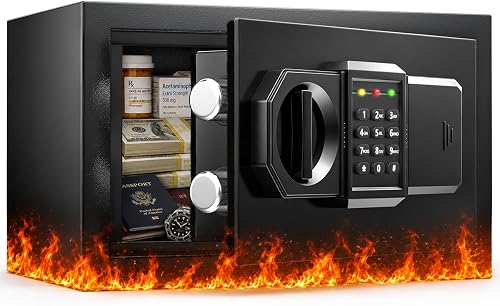
Bonsaii Electronic Keypad Safe
7.3/10 our score
See it on Amazon
How we chose the best small home safes
We compared usable space, access methods, installation options and evidence of fire protection. Those factors matter more than a long feature list when you're choosing a safe for one specific cupboard or a small set of belongings.
Fire protection gets separate attention because a steel shell, a bundled bag and an independently classified fire chest are different things. We give the SentrySafe the lead for document protection without treating every keypad model as a substitute.
For personal storage, the better choice depends on how you reach and organize your items. A shelf can be more useful than a light for mixed belongings, while accessible backup power matters if changing batteries would otherwise require opening the door.
These are compact storage options, not interchangeable answers to every security need. If you're storing high-value items, establish any insurer requirements before choosing a small box.
| Product | Best for | Interior size (H x W x D) | Weight | Lock | Our score |
|---|---|---|---|---|---|
| SentrySafe Small Fire Box | important papers | 3 x 13 x 8.75 in | About 17 lb | Key | 8.1 |
| Small 35-Minute Fireproof Safe | frequent keypad access | Digital keypad or backup key | 7.4 | ||
| Bonsaii Electronic Keypad Safe | organizing everyday valuables | Electronic keypad or emergency key | 7.3 | ||
| Yuanshikj Small Steel Safe | tight cabinet spaces | Electronic keypad or key | 7.3 | ||
| Voncabay Digital Money Safe | dim storage spots | Keypad or override key | 7.0 | ||
| FOWORE Mini Safe | shared living spaces | Keypad or spare key | 7.0 |
Which small home safe suits your belongings?
Choose SentrySafe for flat papers, Bonsaii for organized everyday storage, and one of the mini keypad boxes when a tight footprint is the deciding factor. Pockrif suits buyers who value convenient battery access, but its fire claim needs a separate certification check.
The sections below explain where each model fits and when to pass on it. Keep your actual storage pile nearby as you compare, especially if it includes folders, cases or bulky keepsakes.
SentrySafe Small Fire Box
- Key lock with 2 keys
- UL classified for 1/2 hour at 1550°F
- 3 x 13 x 8.75 in interior
- About 17 lb
A low chest for flat papers and small valuables, with UL-classified fire endurance. Choose it for document protection when key access and a shallow interior suit your storage.
Pros
- UL-classified half-hour fire endurance
- ETL verification covers specified digital media
- Carrying grips
Cons
- Shallow interior limits stacked items
- Key storage needs a separate plan
SentrySafe: the best small home safe for flat papers
Choose the SentrySafe if document fire protection comes before keypad convenience. Its UL classification covers half an hour at 1550°F, and its ETL verification covers CDs, DVDs, memory sticks and USB drives for the same duration and temperature.
The interior is 3 in high, 13 in wide and 8.75 in deep. A bare US letter sheet fits flat, but a folder, envelope or document sleeve may need more room than the paper itself.
The chest layout suits a modest stack you can reach from above. Skip it for upright storage, tall jewelry boxes or a growing archive that would force you to press the lid down over the contents.
A key lock avoids battery care, and the carrying grips help you reposition the roughly 17 lb box. Portability is useful for moving it within the home, but it also means you need a separate plan if preventing removal is your main goal.
SentrySafe offers a lifetime after-fire replacement guarantee. Keep the details needed to use that guarantee somewhere outside the chest, and don't assume the media verification covers every electronic device.
Small 35-Minute Fireproof Safe
- 0.5 cu ft capacity
- Digital keypad and backup keys
- Pockrif claims 35 minutes at up to 1800°F
- Exterior battery compartment
A compact keypad safe with an interior light, optional mounting and batteries you can replace from outside. Pockrif claims fire protection, but confirm independent certification before choosing it for irreplaceable papers.
Pros
- Exterior battery replacement
- Mounting bolts included
- Automatic interior light
Cons
- Independent fire certification needs confirmation
- Mounting requires care around fire-seal plugs
Pockrif: convenient access for frequently used valuables
Choose the Small 35-Minute Fireproof Safe if you want keypad access without opening the door to replace batteries. Its exterior battery compartment addresses a practical concern for a box you expect to use often.
The 0.5 cu ft capacity sits between the mini personal boxes and the Bonsaii. An automatic interior light helps you find small items, while backup keys provide another access route.
Pockrif claims 35 minutes of protection at up to 1800°F. Before making it the sole home for irreplaceable papers, confirm independent certification and which contents it covers; the temperature figure alone doesn't make it a stronger fire choice than SentrySafe.
Optional mounting uses pre-drilled holes and included expansion bolts. Pockrif says factory-installed metal plugs help maintain fire protection before mounting, so follow its directions rather than removing plugs simply because you can.
This is a useful option for frequent access in a cabinet or closet where the door can open fully. Skip it if your buying decision depends on an already identified independent fire classification, and confirm exact exterior clearance because the supplied height and depth measurements vary slightly.
Bonsaii Electronic Keypad Safe
- 0.6 cu ft capacity
- Removable shelf
- Emergency keys and Type-C backup power
- Pre-drilled mounting holes
The removable shelf separates small valuables instead of leaving everything in one pile. Choose it for organized keypad storage when the larger footprint fits your cabinet.
Pros
- Removable shelf
- Type-C backup power
- Felt-lined bottom
Cons
- Power bank and cable are not included
- Larger footprint than the mini boxes
Bonsaii: separate small valuables instead of stacking them
Choose the Bonsaii if organization is the reason you're moving beyond a tiny box. Its removable shelf lets you separate items such as a jewelry pouch and passport wallet, rather than reaching through one mixed pile.
The 0.6 cu ft capacity is the largest stated capacity among these picks. Keep the shelf when it creates useful layers, or remove it when one taller container matters more than separation.
A personal code handles routine access, emergency keys provide a backup, and a Type-C port supplies emergency power. You'll need your own power bank and cable, and external power won't replace the correct code.
Its felt-lined bottom helps protect items from contact with the metal floor. Use individual pouches for pieces that could scratch each other, since lining the bottom doesn't separate the contents.
Pre-drilled holes and included expansion screws support installation inside a wall cabinet. Choose it when that cabinet has enough room for both the body and door movement; skip it when certified fire protection or the smallest possible footprint is the main requirement.
Yuanshikj Small Steel Safe

- 6.29 x 8.9 x 5.12 in interior
- Digital keypad and 2 emergency keys
- Pre-drilled wall or floor mounting holes
- 5.8 lb
A compact steel box for a small group of personal valuables, with mounting hardware included. Its size suits tight spaces, but plan to secure it rather than rely on its weight.
Pros
- Small cabinet footprint
- Keypad plus emergency keys
- Mounting bolts included
Cons
- Limited room for papers and containers
- Easy to carry away if left unsecured
Yuanshikj: a small box for a short storage list
Choose the Yuanshikj when a tight cabinet space rules out larger keypad safes. Its exterior measures 9.05 in wide, 6.69 in deep and 6.69 in high, making it a candidate for a small, measured storage spot.
The interior dimensions are 6.29 x 8.9 x 5.12 in. Compare each item in its case or pouch, because a compact safe can hold loose valuables while rejecting the container you normally keep them in.
A keypad and 2 emergency keys provide everyday and backup access. Steel walls and dual locking bolts create physical barriers, but don't use those features as a substitute for a defined burglary-resistance requirement.
Wall or floor mounting holes and bolts are included. At 5.8 lb, the safe is easy to carry if left loose, so mounting should be part of the plan when preventing removal matters.
Pick it for a limited group of small belongings you want behind a code. Skip it for full-size document storage, bulky jewelry cases or a collection likely to grow quickly; buying too small can leave the most awkward items outside the safe.
Voncabay Digital Money Safe

- 0.23 cu ft capacity
- Keypad and override keys
- 30-second light after keypad access
- Document bag included
A small cash-and-valuables box whose light comes on after keypad access. The included document bag is separate protection and does not establish a fire endurance rating for the safe.
Pros
- Light after keypad access
- Low-battery indicator
- Override keys
Cons
- Small interior limits document storage
- Bag does not establish the safe's fire endurance
Voncabay: easier access in a dim cupboard
Choose the Voncabay if you keep a few small items in a dim storage spot. Opening it through the keypad brings on an interior light for about 30 seconds, which helps when sorting small belongings.
Its usable interior measures 8.6 x 6.2 x 6.1 in. That space suits a small collection rather than full-size flat papers, and any pouch or protective bag takes up part of the available room.
The keypad enters a 5-minute lockout after 3 consecutive incorrect codes. That delay makes careful code entry worthwhile, particularly if more than one authorized person uses the safe.
A low-battery indicator gives you a reason to replace batteries before access becomes a problem. Keep the override keys separately, and remember that the light behavior described here applies to keypad access.
Voncabay includes a bag it describes as fireproof and waterproof. Choose this model for compact, illuminated personal storage, and skip it if you need an established fire endurance rating for the safe itself or enough room for a household document file.
FOWORE Mini Safe

- 0.3 cu ft capacity
- Keypad, spare keys and external battery box
- Alarm with silent mode
- Back and bottom mounting holes
A light-duty personal safe with a quiet keypad option and several backup access methods. It suits small belongings in shared housing where installation is allowed, rather than heavy-duty security or certified fire protection.
Pros
- Buzzer can be silenced
- External battery box
- Interior light
Cons
- FOWORE describes it as light duty
- No shelf
- Safe is not water resistant
FOWORE: light-duty storage in shared housing
Choose the FOWORE if you want a personal storage boundary in shared housing, with a buzzer you can silence. Its keypad, spare keys and external battery box give you several ways to manage access.
FOWORE describes it as light duty, so match expectations to that role. It suits small valuables and a few documents rather than thick binders, multiple books or a high-security storage plan.
The open interior has no shelf, making pouches useful for separating jewelry, spare keys and papers. An interior light helps you see the contents without adding another object to the storage space.
After 3 consecutive incorrect codes, the safe locks and sounds an alarm. Silent mode lets you turn the buzzer off, which can be useful when you share a room, but decide whether quiet access or an audible warning matters more.
Back and bottom mounting holes offer placement options where installation is allowed. FOWORE includes a bag described as fireproof and waterproof, but the safe itself is marked not water resistant; skip it when fire certification or whole-safe water protection is essential.
How much usable space does a small home safe need?
Choose enough room for your current belongings in their normal containers, plus space to remove them easily. Capacity in cubic feet is a starting point, but the shape of the interior decides what fits.
Make a storage pile before you shop. Include envelopes, jewelry cases, passport holders and any protective bag you intend to use, rather than measuring only the bare objects.
Check the longest item first, then the full stack's height. A shallow chest may suit flat papers better than a taller mini safe, while the taller box may work better for a small keepsake.
Allow room for your fingers and for taking out one item without scattering everything else. A safe packed to its edges becomes harder to use and easier to leave disorganized.
If papers will drive the size decision, use our guide to what to keep in a home safe to trim the pile. Then follow our advice on how to store documents at home to separate originals from copies.
Measure the storage spot as well as the safe
Check door or lid clearance, not just whether the closed box fits. A chest needs room above it, while a front-opening safe needs space to swing the door and reach the back.
Make a cardboard outline of the exterior footprint if the cupboard is tight. Check nearby hinges, shelf lips and trim, and consider whether you can comfortably reach the keypad or keyhole once the safe is in place.
A shelf must also support the safe and its contents. Choose a location you can use without balancing the box on an edge or moving heavy objects every time you need a passport.
Do you need fire protection, access control or both?
Choose fire protection for heat-sensitive contents and access control to limit who can reach them. Neither a keypad nor a heavy-feeling door establishes fire endurance, and a fire classification doesn't establish burglary resistance.
For papers, look for an independent classification with a duration, exposure conditions and covered contents. Our guide to what a 1-hour fireproof safe rating means explains how to read that kind of protection.
Don't rank safes by temperature alone. Different claims may use different methods, so a higher number isn't enough to establish better protection for your documents.
Digital media needs its own attention because protection for paper doesn't automatically cover drives or photos. Match any stated media coverage to the actual item you plan to store.
Treat a protective bag as a separate layer
An included bag doesn't give the surrounding safe a fire endurance rating. It may also reduce the space available, especially when you fold or close it around papers.
The same separation applies to water protection. A bag described as waterproof doesn't establish that the safe can withstand flooding, and a water-resistant label doesn't establish protection during submersion.
Our fireproof and waterproof home safe guide explains those differences. For a storage plan centered on portable papers, compare our fireproof document box guide as well.
Should you mount a small safe or keep it portable?
Mount a suitable safe if making removal harder is part of your goal. Choose a portable chest when moving the contents is a deliberate part of the storage plan.
Concealment helps keep a safe out of casual view, but it doesn't secure a loose box to the building. Likewise, attaching a safe to a removable shelf leaves the shelf itself as part of the weak point.
Follow the safe's instructions and choose a sound mounting surface. Included bolts aren't suitable for every wall, floor or cabinet, so identify the material and check for hidden pipes or wiring before drilling.
Renters should confirm permission before attaching anything to the property. If mounting isn't possible, decide whether a portable box still meets your needs instead of treating a hidden location as equal protection.
Don't drill new holes in a fire-protective chest or alter seals to make installation easier. Changes to the enclosure may affect the protection you bought it for.
How should you set up a small keypad safe?
Set up access with the door open and the safe empty. Confirm that the code and backup method work before placing important belongings inside.
Follow the manual for battery type, orientation and code setup. Choose a code that isn't an address, birthday or simple sequence, and keep it out of view when entering it.
Check the new code several times while the door remains open, following the manual's instructions for the locking bolts. Then close the empty safe and confirm normal access before loading it.
Store override keys in a separate secure place, not inside the safe or beside it. If another household member may need emergency access, make that plan clear before a lost key or forgotten code creates a problem.
For external backup power, keep the required cable, battery box or power source somewhere reachable. Power can restore a depleted electronic lock, but you'll still need the correct code or an authorized key.
Arrange the contents so nothing presses against the door, locking parts or battery cover. Keep frequently used items near the front, with small loose pieces in separate pouches.
How do you care for a small home safe?
Keep the safe dry, uncluttered and easy to operate, and deal with battery warnings promptly. Regular attention prevents avoidable access problems and helps protect the contents.
Check electronic locks on a routine schedule and before travel when you expect to need passports. Replace batteries as directed, and inspect the compartment for signs of leakage rather than leaving depleted cells in place.
Put only dry belongings inside. Follow the manufacturer's moisture-care directions, and inspect stored papers periodically, especially if the safe sits in a humid part of the home.
Keep seals, hinges and locking areas free of loose paper, grit and overfilled pouches. Don't force a reluctant door or add lubricant unless the manual calls for it.
Keep a simple inventory outside the safe so you know what belongs inside. After taking out a document, return it to its assigned pouch or folder instead of letting the safe become a pile of unrelated papers.
Which small-safe buying mistakes matter most?
The biggest mistakes are buying too small, confusing different kinds of protection and overlooking backup access. Each can leave you with a safe that doesn't solve the problem you bought it for.
- Buying by exterior size alone: insulation, door thickness and locking parts reduce the room available for belongings.
- Choosing features before contents: a light or alarm won't help if your certificate folder doesn't fit.
- Relying on weight: a box that feels substantial can still be carried away when left unsecured.
- Treating an alarm as physical resistance: a warning can draw attention, but it doesn't secure the safe to its location.
- Keeping every access method together: a key beside the safe weakens access control, while a key inside it can't help during a lockout.
- Overfilling the interior: compressed papers and trapped pouch edges can interfere with closing the door.
- Assuming a bundled bag protects everything: bag claims don't establish fire or water protection for the complete safe.
Avoid choosing a safe so small that you immediately need a second unsecured storage spot. If your pile includes several folders or bulky valuables, compare the larger options in our best home safe guide before forcing everything into a mini box.
Which is the best small home safe for your home?
The best small home safe is the one that fits your belongings and addresses your main risk. Decide that risk first, then choose the access method and storage layout you'll use consistently.
Choose the SentrySafe Small Fire Box for flat papers when documented fire endurance matters most. Choose Bonsaii for everyday valuables that benefit from a shelf, or Pockrif for frequent keypad access with convenient battery replacement after checking any fire certification you require.
Pick Yuanshikj when the available cabinet space is especially tight. Choose Voncabay for a few items in a dim spot, or FOWORE for light-duty personal storage where a quiet keypad option is useful.
Before ordering, measure the complete storage pile and confirm the installation plan. Our home safe size guide helps you leave room for your belongings, your hands and the door or lid.
Our top 3 picks at a glance
-
1
-
2
-
3
Best for organizing everyday valuables
Bonsaii Electronic Keypad Safe
7.3/10 our score
See it on Amazon
Frequently asked questions
What size small home safe should I choose?
Choose by the interior dimensions of your largest item, including its folder, pouch or case. Leave room to lift items out without emptying the whole safe.
Exterior measurements tell you where the box fits, while usable interior space and the door opening determine what you can store.
Are small home safes fireproof?
Some provide time-limited fire protection, but a steel body alone does not establish it. SentrySafe has UL-classified half-hour endurance at 1550°F; Pockrif claims 35 minutes at up to 1800°F.
Choose by independent certification, covered contents and duration, rather than comparing temperature figures alone.
Should I choose a keypad or key lock?
Choose a keypad for frequent access without carrying a key, and choose a key lock if avoiding battery care matters more. Either way, keep backup keys outside the safe in a separate secure place.
External power can address depleted batteries, but it does not replace a forgotten code.
Can I mount a small home safe?
You can mount models designed for it, using their instructions and fasteners suited to the surface. Check the wall, floor or cabinet before installation, including what lies behind it.
Supplied bolts do not make every surface suitable, and renters should confirm permission before drilling into the building.
Can a small safe hold important documents?
Yes, if its usable interior fits the papers and any protective folder without damaging folds. Passports need much less space than certificates, full-size sheets or binders.
Make a stack of everything you plan to store before choosing; our guide to storing important documents at home explains how to organize it.


