Amazon Basics Steel Security Safe Review: Worth It? (October 2026)
The Amazon Basics 1.8 Cu Ft Safe is the best choice here for a larger collection of home valuables. Choose the 1.2 cu ft model for low shelves or the 1 cu ft model for tighter height limits; require separate evidence of fire protection before storing irreplaceable papers.
On this page (9 sections)
- Amazon Basics safe review: which model suits your home?
- How do you choose the right Amazon Basics safe size?
- What protection should you expect from these steel safes?
- How should you mount and set up the safe?
- How should you manage keypad codes and backup keys?
- How do you organize and care for the contents?
- Can these Amazon Basics safes protect papers in a fire?
- Which buying mistakes matter most?
- Which Amazon Basics safe should you pick?
The Amazon Basics 1.8 Cu Ft Safe is the best Amazon Basics safe here for a larger collection of home valuables, provided you have room for a tall cabinet. The two shorter models make more sense under low shelves, with the 1.2 cu ft version offering more room on the same footprint as the 1 cu ft option.
These steel security safes suit households that want keypad access to documents, jewelry, cash and small devices. Fire protection needs a separate decision: don't treat steel construction as proof that irreplaceable contents will survive a fire.
Amazon Basics safe review: which model suits your home?
Choose the 1.8 cu ft model for capacity, the 1.2 cu ft model for a low shelf, or the 1 cu ft model when every inch of height matters. Cabinet shape matters as much as the capacity figure.
TallShelf's scores reflect storage space, cabinet fit, access and mounting features. They are editorial comparisons, not measures of forced-entry resistance.
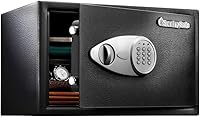
Amazon Basics 1.8 Cu Ft Safe: for a larger collection
Amazon Basics 1.8 Cu Ft Safe

- 1.8 cu ft capacity
- Programmable electronic keypad
- Backup key
- Interior shelf
- Floor or wall mounting
Choose this taller cabinet for a larger collection of documents, jewelry and devices. Its narrower footprint suits spaces where the two shorter models would take up too much width.
Pros
- Largest capacity in this comparison
- Interior shelf separates stored items
- Backup key included
- Floor or wall mounting hardware included
Cons
- Needs more vertical clearance
- AA batteries are not included
This is the strongest fit for a household storing several kinds of valuables together. Use the interior shelf to separate small jewelry cases or cash envelopes from larger items, rather than building a pile you must empty whenever you need something.
Its cabinet measures 13.8 x 13 x 19.7 inches, in width, depth and height. That taller shape gives it a narrower, shallower footprint than either smaller model, which can help in a narrow closet.
Construction includes an 8-gauge steel door, a 14-gauge steel body, two live-door bolts and concealed, pry-resistant hinges. Those are useful security features, but they don't establish a burglary-resistance grade or fire protection.
Choose it if your collection is growing and you can provide a suitable mounting location. Skip it for a low cubby, or if your main need is to store wide folders flat: more total capacity does not mean more width.
Plan the shelf arrangement before filling it. Keep frequently needed items within reach so the extra space remains useful.
Amazon Basics 1.2 Cu Ft Safe: for low storage spaces
Amazon Basics 1.2 Cu Ft Safe
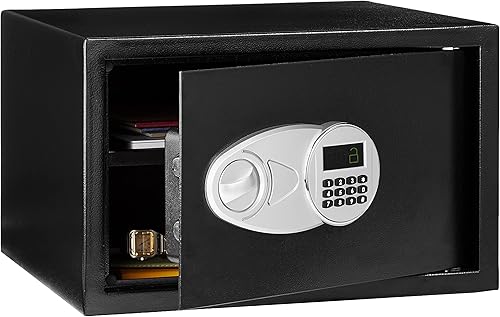
- 1.2 cu ft capacity
- Digital keypad
- Two emergency override keys
- Adjustable removable shelf
- Carpeted floor
A useful middle choice for a low storage spot with enough width and depth. The adjustable, removable shelf lets you divide small valuables or make room for a taller case.
Pros
- Shelf adjusts or comes out
- Two emergency override keys
- Mounting bolts included
- Carpeted floor helps limit scratches
Cons
- Same footprint as the smaller-capacity model
- Four AA batteries are not included
The 1.2 cu ft version is the better choice when you need a short cabinet but can spare some height above the smallest model. It measures 16.93 x 14.57 x 10.63 inches, so it needs a fairly broad shelf or closet floor.
Its adjustable, removable shelf gives you two useful layouts. Divide the compartment for small cases and envelopes, or remove the shelf when one taller item would otherwise prevent the door from closing.
A carpeted floor helps limit scratches from contact with the steel base. Keep jewelry in separate pouches or boxes anyway, since a soft floor cannot stop pieces from rubbing against one another.
Choose this model if the shorter cabinet shape fits your room and you want more storage than the 1 cu ft version provides. Skip it if your available space is narrow or shallow.
It weighs 26.84 pounds before you add anything. Check the support beneath it, especially when installing it on furniture rather than a solid floor.
Amazon Basics Digital Steel Safe: for tight height limits
Amazon Basics Digital Steel Safe

- 1 cu ft capacity
- Digital keypad
- Two emergency override keys
- Adjustable removable shelf
- Carpeted floor
Pick the shortest cabinet when the taller options won't fit and your storage needs are modest. It saves height rather than floor or shelf space.
Pros
- Shortest cabinet in this comparison
- Adjustable removable shelf
- Two emergency override keys
- Mounting bolts included
Cons
- Least interior capacity here
- No footprint savings over the 1.2 cu ft model
- Four AA batteries are not included
The 1 cu ft model earns its place through its 9.06-inch exterior height. Its width and depth match the 1.2 cu ft version, so it saves vertical clearance rather than shelf area.
That makes it a sensible choice for a shallow-height compartment and a modest collection of valuables. Think passports, envelopes and small jewelry cases, with enough spare room to remove each item without disturbing everything else.
Its shelf adjusts or comes out, and the carpeted floor helps reduce scratches against the base. Removing the shelf can simplify storage when dividing an already short compartment leaves neither level tall enough for your cases.
Choose it when the taller model physically won't fit. If both fit comfortably, the 1.2 cu ft version gives you more storage within the same width and depth.
Skip this model if you expect to add bulky cases or many folders. Filling a small safe to the door makes access awkward and increases the chance that loose contents will obstruct closing.
How do you choose the right Amazon Basics safe size?
Choose by the shape of your contents and the available installation space, then use capacity to compare the remaining options. A roomy cabinet can still be wrong for one wide folder or rigid case.
Gather what you intend to store before measuring. Include document sleeves, jewelry boxes and protective cases, since their outer dimensions determine the space you need.
The usable interior measurements below are width x depth x height:
| Model | Interior dimensions |
|---|---|
| 1.8 cu ft | 13.62 x 10.35 x 19.53 in |
| 1.2 cu ft | 16.77 x 11.93 x 10.47 in |
| 1 cu ft | 16.77 x 11.92 x 8.74 in |
A bare US letter sheet measures 8.5 x 11 inches, but folders and envelopes extend beyond those edges. Legal-size papers need more length, so check their full container instead of assuming that “documents” means every paper format.
Make a simple cardboard outline of the interior floor if you are unsure about your arrangement. Place your cases within it, then consider shelf height and the space needed to lift items out.
Leave room around the installed safe to use the keypad and open the door. A cabinet that fits into a recess may still be awkward if an adjacent wall blocks access.
Our guide to choosing the right home safe size covers capacity planning in more detail. Allow some room for future documents rather than sizing the safe around today's exact pile.
What protection should you expect from these steel safes?
These models provide a locked storage barrier, but their stated features do not establish protection against every theft method. All three have two live-door bolts and concealed, pry-resistant hinges, and none has an alarm.
A safe's weight is not a substitute for securing it. A portable locked cabinet can still be carried away, so the mounting plan belongs in the buying decision.
Think about who you want to keep out and how valuable the contents are. Keeping household items behind a keypad is a different requirement from storing a high-value jewelry collection.
If you need documented forced-entry resistance, compare safes with evidence that addresses that requirement. Don't choose solely by door thickness, bolt count or the word “steel.”
Our home safe guide explains common safe types. For a broader shortlist, compare the best home safes for documents and valuables before settling on this cabinet style.
How should you mount and set up the safe?
Choose a sound mounting surface and suitable hardware before loading the safe. The largest model has pre-drilled holes and hardware for floor or wall mounting; the smaller two include four bolts for wall, floor or shelf mounting.
Included hardware does not suit every wall or floor material. Follow the instructions for the chosen surface, and get help if you cannot identify a secure fixing point.
Before drilling, check for pipes, wiring and any restrictions on altering the property. For a shelf installation, consider both its load capacity and how firmly it connects to the surrounding structure.
A well-fastened safe on a weak, removable shelf leaves the shelf as the weak point. Concealment can add discretion, but it cannot replace secure attachment.
With the door open, install the batteries and program your code according to the manual. Confirm keypad operation and key access several times before putting valuables inside and closing the door.
Check that nothing catches around the door or bolts. Papers, straps and loose pouches should sit fully inside the compartment rather than pressing against the closing edge.
How should you manage keypad codes and backup keys?
Keep a private code and a separate recovery route. All three use programmable electronic access and AA batteries; the two smaller models require four batteries, and batteries are not included.
The largest model includes a backup key, while each smaller model includes two emergency override keys. Store those keys somewhere secure outside the safe, away from an obvious nearby drawer.
Avoid birthdays, addresses and simple repeated digits for the code. Share it only with people who need access, and change it when that access should end.
If another household member may need documents in an emergency, agree on an access plan. A safe that only one person can open can create delays when that person is unavailable.
Keep the manual and model details somewhere you can reach without opening the cabinet. Follow its battery guidance, and check operation before travel or another time when reliable access matters.
How do you organize and care for the contents?
Use separate containers and clear groups so you can retrieve items without emptying the safe. Group identity papers, financial documents and jewelry separately, with frequently needed items near the front.
Use labeled folders that fit without bending, and avoid overfilled envelopes. Keep loose jewelry in individual pouches or divided cases so pieces do not rub together.
The larger model has an interior shelf, while the smaller models let you adjust or remove theirs. Choose the layout around your tallest items instead of keeping the shelf in place simply because it arrived that way.
Store papers and valuables dry. Avoid putting damp documents or wet pouches into an enclosed cabinet, and inspect stored papers periodically for moisture or damage.
Wipe accessible surfaces with a soft cloth and keep dirt away from the keypad and door edge. Follow the manual before applying cleaners or lubricants around the lock.
A safe should also be part of a backup plan. Keep recoverable digital copies of suitable documents elsewhere, and avoid storing the only copy of essential information in one place.
Can these Amazon Basics safes protect papers in a fire?
Don't choose these three models for fire protection without a verified fire rating covering your contents. A steel cabinet and a working lock do not establish how much heat its interior can withstand.
For irreplaceable papers, decide on fire protection before choosing the cabinet size. Read what fireproof safe labels mean so you can compare the duration and contents covered by a stated rating.
Paper, photographs and digital media can need different protection. A claim aimed at paper storage should not automatically guide a decision about drives or other heat-sensitive items.
Water protection is separate, too. Don't assume that a fire-resistant safe will protect contents from leaks, flooding or firefighting water.
Avoid treating a document pouch inside an ordinary steel safe as proof of protection for the whole setup. Choose a storage system with evidence that matches the hazard you want to address.
Which buying mistakes matter most?
The biggest mistakes are choosing by capacity alone, skipping mounting and assuming fire protection. Each can leave you with a safe that fits the room poorly or fails to address your main reason for buying it.
Don't buy the shortest model just because it sounds smallest. The two shorter cabinets need the same width and depth, and both have broader footprints than the tallest option.
Don't fill the safe before confirming access and recovery procedures. Set the code, check the keys and choose their storage location while the cabinet is empty.
Don't let a convenient location override a secure installation. A thin furniture panel may be easy to reach but unsuitable as the main mounting surface.
For more help balancing access, placement and protection, use our guide to choosing a home safe. Set those priorities before comparing extra features.
Which Amazon Basics safe should you pick?
Pick the 1.8 Cu Ft Safe for a larger collection, provided its tall cabinet fits and you can secure it properly. Choose the 1.2 Cu Ft Safe when you need a low cabinet; choose the Digital Steel Safe when the lower height is essential.
If irreplaceable papers or a high-value collection drive the decision, establish the required protection first. The right Amazon Basics safe is the one that meets your storage and access needs without substituting cabinet size for evidence of protection.
Our SentrySafe vs Amazon Basics comparison helps with the brand decision, while our small home safe guide offers more compact options.
Before ordering, write down your contents, installation measurements and backup-key plan. Then use our guide to storing important documents at home to decide which originals belong inside and which records also need copies elsewhere.
Frequently asked questions
Is the Amazon Basics safe fireproof?
These three Amazon Basics steel security safes should not be chosen for fire protection without a verified fire rating. Steel walls alone do not establish protection for papers or devices.
Our Amazon Basics fireproof safe guide explains what to check when fire resistance is part of your storage plan.
Which Amazon Basics safe is largest?
The Amazon Basics 1.8 Cu Ft Safe has the most capacity of these three models. Its cabinet is taller, narrower and shallower than the other two options.
Choose it for a larger collection, but compare your actual folders and cases with the interior dimensions before deciding that everything will fit.
Do these Amazon Basics safes need batteries?
Yes, all three use AA batteries for keypad operation, and batteries are not included. The 1 and 1.2 cu ft models each require four AA batteries.
Each safe also includes key access, so keep the backup keys secure and accessible somewhere other than inside the safe.
Can you bolt down an Amazon Basics safe?
Yes, all three include mounting hardware. The 1.8 cu ft model supports floor or wall mounting, while the smaller models include bolts for wall, floor or shelf mounting.
Follow the supplied instructions and choose anchors suited to the surface; a weak shelf or cabinet can undermine the installation.